Bonded phase Custom Development Widening the options for PharmX the next generation of drugs
Built on surface bonding of spherical fully porous silica, we develop dedicated stationary phases in which pore size, particle size and bonded phase are matched in three dimensions to the molecular size, polarity and process scale of the target — from complex peptides and insulin to aromatic compounds, turning separation selectivity into a process moat for the customer's high-value product.
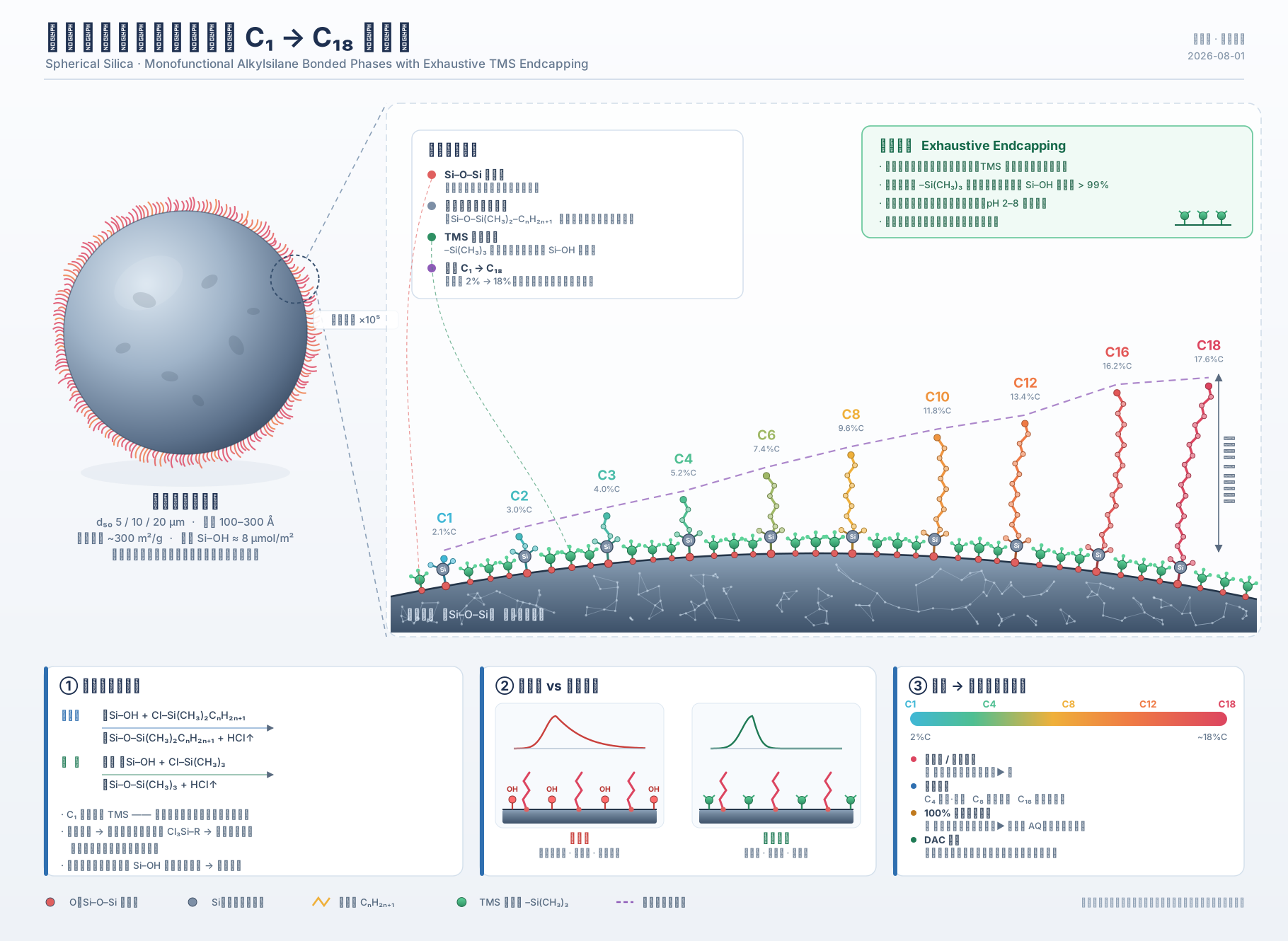
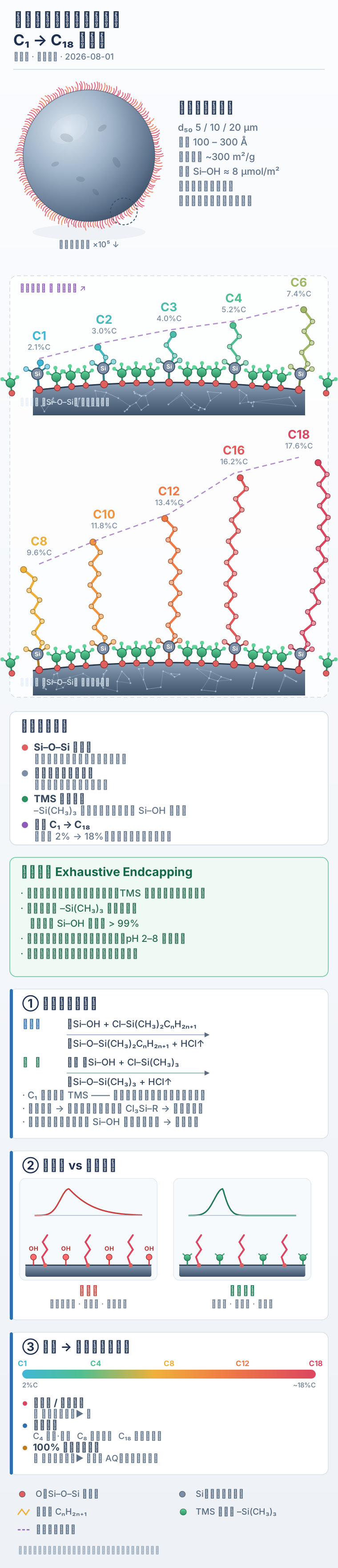
Fig. 1 · Alkyl bonded phases C₁ → C₁₈ on spherical silica — left, the fully porous spherical particle; right, the surface at ×10⁵: chain length sets the thickness of the hydrophobic layer and the carbon load, while residual Si–OH groups that steric hindrance keeps the long chains from reaching are filled one by one by a second (and where necessary third) TMS silylation. The figure is schematic and not to scale; the carbon loads shown are industry-typical values for a 100 Å, ~300 m²/g substrate, not measured data for any particular grade. On mobile the figure switches automatically to a portrait layout.
01 · Ground-Up Development Capability
Bonded phase development from scratch: a new phase designed around the customer's sample
We start from the structural character of the sample to be separated — the molecular size and conformation of the target, its hydrophobicity, its charge and ionization behaviour, and exactly which structural feature separates the critical impurity from the main peak — and work backwards to the interaction needed to genuinely pull them apart, then turn that judgement into a specific bonded phase product.
From silane molecular design and bonding route development through endcapping and post-treatment to scale-up and batch-to-batch control, the whole chain is carried out on our own production line: no bought-in intermediates and no dependence on an existing recipe. When a customer's separation problem has no answer in the commercial catalogue, our starting point is not "try another grade" but a design created for that sample.
From sample characteristics to production · the full chain in house
01Sample characterization Molecular size and conformation, hydrophobicity, charge and ionization behaviour, and the structural differences between the critical impurities and the main peak
02Mechanism and molecular design Selecting the functional group, chain length and spacer structure on that basis, defining the origin of selectivity at the molecular level
03Bonding route development The reaction system, catalysis and temperature control are established and validated from first principles rather than copied from existing parameters
04Endcapping and post-treatment Degree of endcapping, washing and activation conditions are each fixed; they directly determine peak shape, pH window and column life
05Scale-up and batch consistency Scaled step by step to ton scale, with carbon load, pore structure and chromatographic performance as batch release criteria
The chain starts from the customer's sample, not from our inventory — which is what makes a dedicated phase possible, and what allows the same chromatogram to be reproduced years and dozens of batches later.
02 · Physical Starting Point for Customization
Spherical fully porous silica: how far the surface chemistry can go depends on what is underneath
A bonded phase is a layer of surface chemistry, but how much that chemistry can achieve depends on the silica skeleton beneath it. A spherical fully porous structure provides three things nothing else does: a continuously adjustable pore structure, a particle size that can be held to a narrow distribution, and mechanical strength sufficient for industrial linear velocities and in-line cleaning. Microwants works from its own bonding line, with SilicaOne as an ultra-pure spherical fully porous substrate that removes metal ions and surface defects as a source of variability at the outset.
≥ 99.99%Silica substrate purity Fewer acidic surface sites and less non-specific adsorption
< 10 ppmTotal metal impurities Suppresses tailing and oxidative degradation of chelating compounds
60 – 2000 ÅPore size range available From small molecules to plasmid-scale macromolecules
3 – 60 μmParticle size range available Analytical grade through to ton-scale industrial preparative
Spherical morphology — reproducibility of the bed
Spherical particles pack densely with an even void distribution, giving low column pressure and uniform flow. Compared with irregular silica, a spherical substrate keeps the bed stable under repeated packing and recompression in dynamic axial compression (DAC), which is a prerequisite for transferring a laboratory method to an industrial preparative column.
Low column pressureDAC scalableStable bed
Fully porous structure — the source of loading and retention
Almost all the surface area of fully porous silica lies inside the pores, so pore size and surface area are strongly coupled: widen the pore size by one step and surface area falls with it, changing both the total bondable functionality and the loading capacity. Pore size is therefore not an independent parameter but the master variable governing both molecular accessibility and the loading ceiling.
Ultra-pure substrate — the root cause of peak shape and batch drift
Aluminium, iron and other metals in the substrate activate neighbouring silanols and raise their acidity appreciably, causing basic drugs and chelating compounds to tail and introducing uncontrolled selectivity drift between batches. Total metal impurities in the SilicaOne substrate are held below 10 ppm, removing this variable from the process risk list.
Metals < 10 ppmPeak shape for basic compoundsBatch consistency
Mechanical strength — the hidden threshold for industrial preparative work
Preparative columns run at high linear velocity with frequent packing and unpacking and in-line acid and alkali cleaning; particle fracture immediately raises column pressure, blocks frits and shortens column life. Custom projects fix the skeletal strength target at the substrate selection stage against the intended column pressure and cycle count, rather than looking only at chromatographic parameters.
Customization is not picking a grade from a catalogue but finding, on three mutually constraining axes, the one point that matches both the target molecule and the process scale. Pore size determines whether the molecule can get in, particle size sets the trade-off between efficiency and pressure drop, and the bonded phase determines where selectivity comes from. Get any one of the three wrong and the other two cannot compensate.
Axis 1 · pore size: first solve "can it get in"
Pore size must be fixed before the bonded phase. When a molecule diffuses under confinement inside the pore, retention, loading and efficiency all deteriorate together, and at that point any adjustment to the bonded phase is wasted effort.
Pore size platform
Typical surface area
Suited to
Common custom phases
60 Å
~450 m²/g
Small-molecule APIs, amino acids, short peptides (≤ 10 aa)
High carbon load C18 / C8 / diol
100 – 120 Å
300 – 450 m²/g
Small-molecule drugs, synthetic peptides, GLP-1 class lipopeptides
C18 / C8 / phenyl / polar-embedded / HILIC
200 Å
~200 m²/g
Medium molecular weight peptides, insulin and its analogues
C8 / C4 / low carbon load C18
300 Å
~100 m²/g
Recombinant proteins, large peptides, oligonucleotides
C4 / C8 / wide-pore C18
1000 – 2000 Å
15 – 25 m²/g
Very large molecules, long-chain nucleic acids, large-particle biologics
C4 / bare silica / hydrophilic modified
The rule: pore size and surface area are strongly coupled on fully porous silica, and each step up in pore size reduces the bondable surface, lowering carbon load and the loading ceiling together. "Wide pore plus high carbon load" is therefore physically unobtainable, and the priority must be stated at the customization stage.
Axis 2 · particle size: the trade-off between efficiency and pressure drop
Particle size band
Role
Typical use
Metric that matters
3 – 5 μm
Analytical grade
QC methods, impurity profile confirmation, method development
Efficiency N, peak symmetry
7 – 10 μm
Semi-preparative / high-resolution preparative
Impurity preparation, difficult enantiomers and isomers
Principle of scale-up: keep pore size and bonded phase entirely unchanged, adjust only particle size and column dimensions, and transfer the gradient in proportion to linear velocity and column volume — this gives the smoothest method transfer. Change pore size or phase at the same time and the method is effectively being developed again.
Axis 3 · bonded phase: the source of selectivity
Once pore size and particle size are fixed, all remaining separating power comes from the surface chemistry — which is the atlas of available modes set out in the next section.
From C18 to HILIC: an atlas of customizable bonded phase modes
Reversed phase is not the only answer. Real customization capability means being able to choose freely between hydrophobic, aromatic, polar-embedded, hydrophilic and ion-exchange retention mechanisms — and to use the most appropriate interaction to open up the hardest pair of peaks in the customer's system. All six modes below can be bonded and their processes fixed on our own production line to suit the target.
Chain length builds a ladder of hydrophobic strength: C18 for routine reversed phase and high-load preparative work; C8 gives a narrower elution window and better recovery for hydrophobic peptide systems where retention is excessive; C4 for proteins and strongly hydrophobic macromolecules; short C1–C2 chains for rapid elution of very hydrophobic samples; C30 for shape selectivity towards carotenoids, fat-soluble vitamins and the like.
Phenyl phases recognize aromatic ring density and substitution pattern through π–π interaction, giving selectivity orthogonal to what C18 can offer — the key to separating positional isomers, polycyclic systems and analogues with conjugated structures. Spacer length is adjustable, to shift the balance between π–π and hydrophobic interaction.
π–π selectivityPositional isomersUSP L11
Polar-embedded · amide-embedded alkyl chain
An amide or similar polar group is embedded between the alkyl chain and the silica surface, forming a polar layer that shields residual silanols: peak shape for basic compounds improves markedly, phase collapse does not occur in 100% aqueous conditions — suiting high-aqueous gradients and LC-MS compatible methods — and the selectivity differs from conventional C18.
100% aqueous compatiblePeak shape for basic compoundsMulti-mode selectivity
HILIC · diol / amide
For strongly hydrophilic compounds that are barely retained under reversed-phase conditions. Diol phases are neutral with mild hydrogen bonding, suiting carbohydrates and hydrophilic peptides; amide phases are more polar and retain more strongly, suiting nucleotides, amino acids and polar metabolites. The high acetonitrile content of the mobile phase naturally favours electrospray ionization, making these highly LC-MS compatible.
DiolAmideLC-MS friendly
Intermediate polarity and special recognition · cyano / non-endcapped / aminopropyl
Cyano phases are of intermediate polarity and can be used in both normal and reversed phase, suiting fast methods for moderately polar compounds. Non-endcapped phases retain a controlled number of residual silanols, turning hydrogen bonding into an extra dimension of recognition for structural analogues that conventional endcapped phases cannot resolve. Aminopropyl phases provide Lewis base sites, for normal-phase carbohydrate separation and weak anion exchange.
CyanoSilanol recognitionAminopropyl normal phase
Mixed mode and ion exchange · RP-IEX / SCX / SAX / WCX
Hydrophobic and charged sites are built onto the same particle surface, with retention controlled by two independent variables — ionic strength and pH — giving orthogonal separation on a single column. This suits charged peptides, amphoteric compounds and systems that must be desalted and separated at once; both the type of ion-exchange group and the charge density can be tailored to the target's titration curve.
What is controlled is not "attaching it", but how densely and how stably
At the same nominal C18, different combinations of bonding density, silane functionality and endcapping strategy can produce products differing by nearly a factor of two in retention, by three pH units in usable window, and by several fold in column life. These three variables are where the real degrees of freedom in customization lie, and why selectivity can be locked down and written into a specification.
Process variable
Adjustable range
Direct effect on the separation
Silane functionality
Mono- / di- / tri-functional
Trifunctional silanes form a crosslinked polymeric layer at the surface, resisting acid hydrolysis, allowing a lower pH limit and giving longer life; monofunctional silane layers are structurally uniform, with better efficiency and batch reproducibility. The two routes serve different process needs.
Bonding density (surface coverage)
About 2 – 4 μmol/m²
Directly determines carbon load and hydrophobic retention strength. High density gives high retention and high loading, but reduces accessibility for macromolecules in wide-pore substrates; low density favours rapid elution and recovery of macromolecules.
Carbon load
About 3% – 24% (with pore size and phase)
The most direct reading of retention strength and loading. Experience is that once carbon load differs by more than 3%, selectivity requires the method to be recalibrated — which is the underlying reason that "same-name C18" from different manufacturers is not interchangeable.
Endcapping strategy
Fully / partially / not endcapped
Controls the number of residual silanols. Full endcapping is used for peak shape and symmetry with basic APIs; leaving the phase non-endcapped turns the silanols into an extra recognition site for structural analogues that ordinary reversed phase cannot resolve.
Polar embedded group
Amide, carbamate and similar
Prevents alkyl chain collapse under high aqueous conditions, keeping 100% aqueous methods usable, and markedly improves peak shape for basic compounds.
Spacer and terminal group
Short spacer / hydrophilic terminal group
Adjusts the steric accessibility of the bonded layer to macromolecules and suppresses non-specific adsorption of proteins and large peptides, which directly affects recovery.
Usable pH window
Typically pH 2 – 10; high bonding density with full endcapping extends this to pH 1.5 – 12
Determines whether alkaline mobile phases and dilute-alkali in-line regeneration can be used. A peptide commercialization process requiring NaOH regeneration should be designed on the base-stable route from the customization stage.
A custom project fixes these variables in a written specification and includes them in the release testing of every batch. For the customer, that means selectivity no longer depends on the luck of a particular batch of medium but is a reproducible, auditable technical parameter that can be written into a process procedure.
06 · Target-Driven Design
From complex peptides to aromatic compounds: defining the stationary phase backwards from the target
The input to customization is never "what column do I want" but "which pair of peaks do I need to separate, and at what scale". The technical entry points for several typical systems are set out below — the difficulty differs in each case, so the point they occupy on the three-dimensional matrix differs entirely.
Complex peptides and GLP-1 class lipopeptides
The long fatty acid side chain brings strong hydrophobicity and a tendency to aggregate, so the main peak is over-retained on a conventional high carbon load C18 and the elution window is compressed. The entry point is to lower effective hydrophobicity and raise process tolerance: 100–200 Å pores with a medium-to-low carbon load C8 or C4, high bonding density and full endcapping to support dilute-alkali regeneration, with the aim of pulling deletion peptides, epimers and deamidation impurities away from the main peak without sacrificing loading.
C8 / C4100 – 200 ÅBase-stable regeneration
Insulin and its analogues
With over fifty amino acids and existing as a hexamer, the molecular size calls for wider pores to avoid restricted diffusion. The 200 Å platform with C8 is the classic window; the critical separations are the A21 deamidation product, disulfide-scrambled isomers and residual precursor. The focus of customization is maintaining resolution and recovery at high loading, which usually requires a careful balance between bonding density and pore accessibility.
200 ÅC8 as the mainstayHigh loading with recovery
Aromatic compounds and structural analogues
Positional isomers with extensive conjugation and similar hydrophobicity often co-elute entirely under a purely hydrophobic mechanism. The customization approach introduces π–π interaction as a second dimension of recognition: a phenyl or phenylalkyl phase with adjusted spacer length changes the elution order while leaving retention strength largely unchanged. Polycyclic aromatic systems, fullerene derivatives and preparation of aromatic impurities are typical beneficiaries.
Oligosaccharides, nucleosides and nucleotides, amino acids, polar metabolites and strongly hydrophilic peptides have k′ too small under reversed-phase conditions and elute with the dead volume. There are two customization routes: where retention must be raised substantially, go to HILIC (diol or amide); where retention is merely weak, use a polar-embedded or 100% aqueous compatible C18. Both routes can be screened in parallel at bench scale before the phase is fixed.
HILIC Diol / AmidePolar embedded100% aqueous
Oligonucleotides and recombinant proteins
Large molecular size and high charge density make pore size and non-specific adsorption the primary problems. A 300 Å to ultra-wide-pore platform ensures pore accessibility, while short C4 chains or hydrophilic terminal modification reduce irreversible adsorption; charged systems can go further to ion-pair reversed phase or RP-IEX mixed mode, using ionic strength and pH as a second dimension of control.
Bonding is not only for chromatographic separation. Functionalized silica modified with thiol, ethylenediamine, thiourea and other coordinating groups can remove residual palladium, platinum, copper and iron catalysts selectively by complexation and chelation, complementing chromatographic purification on the same process chain. Both capacity and the type of coordinating group can be tailored to the residual metal profile.
Custom projects run in four stages, each with defined technical criteria and deliverables. The core principle is to bring the scale-up constraints forward — the intended production scale, acceptable column pressure, and cleaning and regeneration conditions are written into the design input at stage one, rather than being accommodated after bench work is complete.
Requirements definition and feasibility
Target structure, impurity profile, purity and yield targets, scale and equipment constraints
Design and sample preparation
Fix pore and particle size, design the bonding chemistry and endcapping strategy, prepare candidate samples
Chromatographic validation and process lock-down
Screen candidate phases in parallel, optimize gradient and loading, fix the specification and release criteria
Scale-up and stable supply
Scale the bonding process, validate DAC packing, confirm batch consistency and long-term supply
Stage
Key work
Deliverable to the customer
① Requirements definition
Structural analysis of the target and principal impurities, diagnosis of the existing method, confirmation of production scale and equipment constraints, NDA signed
Technical feasibility opinion and development plan
② Design and sample preparation
Pore and particle size selection, bonded phase and bonding density design, endcapping strategy, small-batch preparation of several candidate phases
Candidate samples with an explanation of the design basis
③ Chromatographic validation
Parallel screening of candidate phases, mobile phase and gradient optimization, loading and recovery studies, chemical stability and regeneration condition validation
Chromatographic data package, recommended phase and process parameters, draft product specification
④ Scale-up and production
Stepwise scale-up of the bonding process, DAC packing validation on preparative columns, confirmation of batch consistency, transfer into routine production and stock planning
The duration of each stage is assessed against the difficulty of the target and the intended scale, and confirmed in a written development plan at project initiation. Routine enquiries and selection advice are answered by the technical team within 24 hours.
08 · Characterization & Quality Control
Batch consistency is what a custom project actually delivers
Achieving a good separation once is not difficult; achieving the same chromatogram on batch 40, three years later, is. The quality system for a custom project is built around this: every physical and chemical variable that affects selectivity is turned into a measurable, judgeable release criterion, with the data retained batch by batch.
Characterization item
Method
What it controls
Carbon load
Elemental analysis (CHN)
The direct measure of bonding density and hydrophobic retention strength — the first gate on batch-to-batch selectivity consistency
Surface area / pore volume / pore size distribution
Nitrogen adsorption, BET / BJH
Determines the loading ceiling and pore accessibility for the target molecule; wide-pore products are especially sensitive
Particle size distribution D10 / D50 / D90
Laser diffraction
Determines column pressure, efficiency and packing reproducibility; the proportion of fines directly affects preparative column life
Residual metals
ICP-MS / ICP-OES
Controls the risk of tailing with chelating and basic compounds, and of oxidative degradation
Degree of endcapping / residual silanols
Tailing factor measured with a basic probe
The key criterion for peak shape with basic APIs and for column-to-column consistency
Chromatographic performance
Standard test for k′ / α / N / As
Verifies batch-to-batch selectivity by actual chromatographic behaviour rather than physical parameters alone
Chemical stability
Accelerated acid / alkali flushing life test
Confirms the usable pH window and tolerance of in-line cleaning (CIP)
Moisture and residual solvent
Karl Fischer / gas chromatography
Ensures compatibility with the downstream process and solvent system, avoiding packing and storage problems
A COA is issued for every batch. For key projects a customer-specific grade, dedicated batch management and a retention sample scheme can be established; the phase, specification and release criteria can be fixed to the requirements of the customer's regulatory filing, with changes handled under an agreed change control procedure.
09 · Commercial Value
A dedicated bonded phase is a moat you can write into the process procedure
A process built on a general-purpose medium can be reproduced by a competitor working from the same purchase order. The separation window a dedicated custom phase provides cannot be bought — it turns the separation method from a recipe that can be inferred from public literature into a process asset tied to the supply chain. That is the most tangible barrier a high-value product can have.
Exclusive selectivity: no one else can buy the same chromatogram
The bonding density, endcapping strategy and surface chemistry of a dedicated phase are designed for your impurity profile. Even reproducing the gradient and mobile phase, a competitor will not obtain the same impurity resolution or purity curve on a general-purpose medium — the critical link in the process is not traded on the open market.
Cost structure: rewriting the economics of unit capacity
Raising the load per batch, shortening the gradient, reducing the number of cycles and cutting solvent consumption — any one of these feeds straight into the cost per unit of capacity. The larger the preparative scale, the greater the cost leverage a custom phase provides, often covering the development investment within a few batches.
Regulatory filing and continuity of supply
Once the phase and batch consistency are written into a regulatory filing, an interruption in media supply becomes a process risk. An in-house bonding line, per-batch COAs, a retention sample scheme and long-term supply arrangements turn that risk from an uncontrollable external variable into a manageable contractual term.
Intellectual property and confidentiality
An NDA can be signed from the requirements discussion stage, setting out ownership and permitted use of the formulation, process parameters and chromatographic data. A customer-specific grade is managed internally under its own item number, does not enter the public catalogue, and is not used in proposals for other customers.
Turn your separation problem into a process others cannot copy
Send us the structure of the target compound, the principal impurities, your current method and the intended scale, and our technical team will assess feasibility and outline an approach.
Pore size 60 – 2000 ÅParticle size 3 – 60 μmC18 / C8 / C4 / phenylPolar embedded / HILICMixed mode / ion exchangeBench to ton scale
Five questions most often asked before customization
Most of these judgements can be made before submitting a request, and doing so shortens the first stage considerably.
Q1 · Should I change the pore size, or the bonded phase first? How do I tell?
Start from whether molecular size and pore size match. Once the hydrodynamic radius of the target approaches a third of the pore diameter or more, entry into the pore is impeded and retention, loading and efficiency fall together; at that point changing the bonded phase achieves essentially nothing and the pore size band must change. As a rule of thumb: 60–120 Å for small molecules and short peptides, 200 Å for medium molecular weight peptides such as insulin, 300 Å for proteins and large peptides, 1000–2000 Å for long-chain oligonucleotides and very large molecules. Only when the pore size is appropriate and resolution is still insufficient is it a question of bonded phase, endcapping strategy and mobile phase.
Q2 · At the same nominal C18, why do different products differ so much in selectivity?
The difference comes from four controllable variables: bonding density (and hence carbon load, commonly 2–4 μmol/m²), silane functionality (mono- or trifunctional), degree of endcapping, and the acidity and metal content of the substrate's residual silanols. Once carbon load differs by more than 3%, retention and selectivity generally require the method to be recalibrated; the degree of endcapping directly determines tailing of basic compounds. The core value of customization is fixing these four variables to the target and writing them into the product specification, so that selectivity is reproducible between batches.
Q3 · What particle size should I choose for preparative scale, and how do I keep the method consistent on scale-up?
Smaller particles give higher efficiency and higher pressure drop, so resolution has to be traded against throughput. The usual bands: 3–5 μm for analysis and method development; 7–10 μm for semi-preparative and high-resolution preparative work; 15–20 μm as the workhorse for industrial DAC dynamic axial compression preparative work; 30–60 μm for crude fractionation, desalting and pretreatment. On scale-up, keep the substrate pore size and bonded phase entirely unchanged, adjust only particle size and column dimensions, and transfer the gradient in proportion to linear velocity and column volume — this gives the smoothest transfer.
Q4 · How do I choose between HILIC and reversed phase?
The criterion is the retention factor under reversed-phase conditions. If the target has k′ below 1 on C18 and elutes essentially with the dead volume, it is not hydrophobic enough to support a reversed-phase separation and you should move to HILIC, using a diol or amide phase with a high proportion of acetonitrile. Carbohydrates, nucleosides and nucleotides, amino acids, polar metabolites and strongly hydrophilic peptides are the typical HILIC candidates. If retention is merely weak but the molecule still has a clear hydrophobic segment, try a polar-embedded or 100% aqueous compatible C18 first — it is a smaller change.
Q5 · Can a custom bonded phase support continuous supply from bench to ton scale?
Yes. A custom project designs the bonding process backwards from the intended production scale at initiation, so bench and scale-up batches use the same raw materials and the same set of process parameters, with carbon load, surface area and pore structure, particle size distribution and chromatographic performance as the four batch consistency release criteria, and a COA issued for every batch. For key projects a customer-specific grade, dedicated batch management and a retention sample scheme can be established, with an NDA setting out ownership of the formulation and process parameters as required.