FULLERENE SEPARATION

Fullerene separation andindustrial preparation

Fullerene separation and purification — five dedicated COSMOSIL columns (Buckyprep, Buckyprep-M, PBB, PYE, NPE) covering analysis and preparative purification of C60/C70 and metallofullerenes.

Fullerene Separation

Industrial preparation of high-purity fullerenes

Fullerenes (C60, C70 and higher fullerenes) dissolve poorly and recover badly on conventional columns, which makes them difficult to separate. The COSMOSIL Buckyprep family, developed specifically for fullerenes, achieves high-loading, tail-free separation and preparative purification in toluene and other good solvents.

C60 / C70 Standard Separation

The Buckyprep column (pyrenylpropyl phase) is the industry reference for fullerene separation. With toluene as the mobile phase, C60 and C70 give sharp, tail-free peaks and the load can be raised considerably relative to a C18 column, making it the first choice for preparative fullerene purification.

Buckyprep Toluene mobile phase Preparative grades available

Metallofullerene Separation

Buckyprep-M is optimized for endohedral metallofullerenes and higher fullerenes, offering selectivity different from Buckyprep and suiting metallofullerenes of similar properties that conventional columns cannot distinguish.

Buckyprep-M Endohedral metallofullerenes Higher fullerenes

High-Efficiency Preparative Purification

The PBB column (pentabromobenzyl phase) gives stronger retention and selectivity than Buckyprep, suiting high-purity preparation of C60/C70 and separation of higher fullerenes (C76, C78, C84 and others) where more resolution is needed.

PBB column Higher fullerenes High resolution

Fullerene derivatives and isomers

The PYE column (pyrenylethyl phase) provides strong π–π interaction and excels at separating structural isomers and derivatives; the NPE column offers complementary selectivity, suited to fine separation of fullerene derivatives in organic photovoltaic materials such as PCBM.

PYE column NPE column PCBM / photovoltaic materials

Feed Material & Target Product

Cage and principal derivative structures, rendered by RDKit as orthogonal projections of the three-dimensional cages. Cages are drawn as skeletal representations without marking 6,6-bond positions; addition sites on fullerenols and fluorinated fullerenes are indicative and n is a representative value — the actual number and distribution of additions depend on the reaction conditions. Swipe horizontally on mobile.
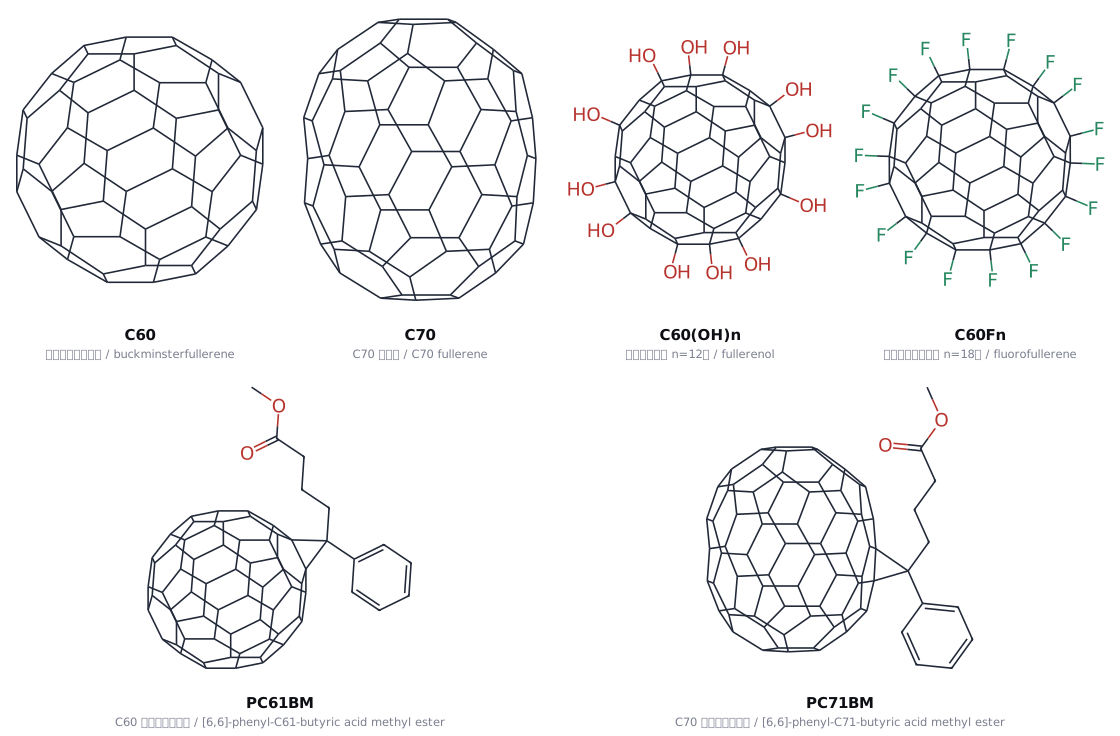
Fullerene cage and principal derivative structures: C60, C70, fullerenol, fluorinated fullerene, PC61BM, PC71BM (rendered with RDKit)
Dedicated columnBonded phaseBest suited toCharacteristics
BuckyprepPyrenylpropylC60 / C70 Standard SeparationThe industry reference; high-load preparative work
Buckyprep-MPhenothiazineMetallofullerenes / higher fullerenesSelectivity complementary to Buckyprep
PBBPentabromobenzylHigh-purity preparation / higher fullerenesStronger retention and resolution
PYEPyrenylethylStructural isomers / derivativesStrong π–π selectivity
NPENitrophenylethylFullerene derivatives / PCBMComplementary selectivity
Note: toluene is the preferred mobile phase for fullerenes, giving high solubility and good recovery; all the columns above are optimized for toluene systems.

Detailed Specs for Five Dedicated Columns

Data from the COSMOSIL fullerene column series; swipe horizontally on mobile for the full comparison.

PackingBuckyprepBuckyprep-MPBBPYENPE
Silica substrateHigh-purity porous spherical silica
Mean particle size5 μm
Mean pore sizeAbout 120 Å
Surface areaAbout 300 m²/g
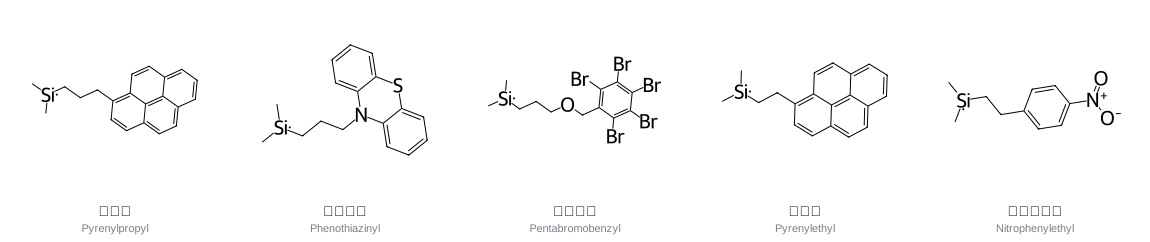
Stationary phase structureMolecular structures of the five bonded phases (rendered precisely from SMILES with RDKit)
Bonded groupPyrenylpropylPhenothiazinePentabromobenzylPyrenylethylNitrophenylethyl
Bonding typeMonomeric
EndcappingNearly completeNoneNearly complete
Carbon loadAbout 17%About 13%About 8%About 18%About 9%
CharacteristicsStandard fullerene separation columnMetallofullerene separationPreparative separation of C60/C70Fullerenes and structural isomersFullerene derivatives

Recommended Configuration for Fullerene Preparation

The core combination from analytical selection to industrial preparative purification

Buckyprep analytical / preparative columns Buckyprep-M (metallofullerenes) PBB (high-purity preparation) PYE / NPE (derivatives) Toluene mobile phase
Get the solution →
Technology Routes

Comparison of Separation & Purification Routes

Extraction of fullerenes is a relatively mature step; the constraints on cost and efficiency sit in separation and refining. The table below compares the main routes reported in public sources by principle, achievable purity and demonstrated scale. Purity and scale are listed as publicly disclosed and have not been verified by us.

TechnologyPrincipleAchievable purityDemonstrated scaleApplicability and limitations
Soxhlet / maceration extractionFullerenes dissolve in toluene, o-xylene and CS₂, separating from amorphous carbonCrude mixtureIndustrial scaleMature and a small share of cost; solvent recovery and residue control govern downstream quality
Alumina / activated carbon column chromatographyDifferences in adsorption strength; C₆₀ elutes before C₇₀About 95%–99%Pilot to industrialLow cost and scalable; limited purity ceiling, with yield lost to irreversible adsorption on the stationary phase
Chlorobenzene elution + activated carbonExploits the higher solubility of C₆₀ in chlorobenzeneReported > 99%Batch production feasiblePublic sources describe it as scalable; chlorobenzene is a controlled solvent with demanding environmental and residue requirements
Preparative HPLCFullerene-specific stationary phases such as pyrenyl, phenothiazine and pentabromobenzyl99.9%–99.99%Kilogram / annual scaleGood purity and cage-type resolution; low throughput, high solvent consumption and a large share of cost in the stationary phase
Fractional crystallizationSolubility differences between C₆₀ and C₇₀ in CS₂ or o-xyleneMainly enrichmentGram scale in the literatureNo stationary phase losses; requires prolonged stirring and sometimes heating, and scale-up efficiency remains to be demonstrated
Selective complexation / host–guest precipitationγ-cyclodextrin, calixarenes, porphyrin cages, triptycene–bowl molecules, AgNO₃ molecular cagesReported up to 99.5% in the literatureLaboratory scaleAvoids the irreversible adsorption losses of chromatography; host molecule cost and recyclability are prerequisites for industrialization
Simulated moving bed chromatographyMulti-column switching gives continuous countercurrent separationDepends on the stationary phaseNo commercial fullerene installation publicly disclosedMature in peptide and chiral separation, and a plausible route to lowering the cost of fine fullerene separation
Vacuum sublimationRemoves residual solvent and low-volatility impuritiesSublimation grade, 99.9%+Kilogram to pilot scaleThe grade dividing line for vacuum deposition applications; energy consumption and yield must be balanced
Note: the table is compiled from public sources, and purity and scale figures for the same route differ between sources. "Demonstrated scale" refers to the largest implementation publicly disclosed and does not indicate current production capacity.

Fine separation is where cost concentrates

Public sources are consistent on this point: extraction is mature, while separation is costly and inefficient, and is the main reason high-purity fullerene prices have stayed high. Competition in industrialization tends to centre on fine separation and sublimation refining rather than on synthesis.

Fine separation Sublimation refining

The stationary phase determines yield and resolution

Yield losses on the chromatographic route come mainly from irreversible adsorption on the stationary phase, which is the argument behind the host–guest route. Using fullerene-specific bonded phases with a toluene system can improve loading and recovery while retaining resolution.

Demand Side

Downstream Applications & Demand Drivers

Different applications differ considerably in their requirements for purity, residual solvent and batch consistency, which in turn determines how far the separation step must go. The table below sets out consumption characteristics, industrialization status and demand drivers; the assessments are inferences from public information.

ApplicationConsumption and specification requirementsIndustrialization statusAssessment of demand pull
Electron transport layers in perovskite and tandem cellsVacuum-deposited C₆₀ thin films, requiring sublimation-grade purity and low residual solvent; consumption per GW of line capacity, calculated from film thickness and utilization, is well above current research and cosmetics demandSeveral GW-scale lines in China came on stream from 2025 and larger-scale manufacturing began in 2026 (per industry reports); because C₆₀ costs are high, some manufacturers use a C₆₀/SnO₂ composite electron transport layerOn publicly available information, this appears the direction most likely to pull ton-scale fullerene capacity. The constraints are raw material price (public sources cite around RMB 200/g) and deposition material utilization
Organic photovoltaics and organic photodetectorsPC₆₁BM / PC₇₁BM or deposited C₆₀; demanding on batch consistencyOPV products are commercially available; organic photodetectors for full-screen fingerprint sensing are described by manufacturers as close to commercializationConsumption per unit area is small, but it generates steady orders for high-purity derivatives and is the main outlet for Japanese combustion-process capacity
Lubricant and lubricating material additivesManufacturers report that around 100 ppm markedly reduces wear on metal parts; mixed fullerenes are acceptableCommercial products exist; early applications included satellite gyroscope lubrication, and Chinese manufacturers have launched additives for trucksPurity requirements are relatively relaxed, so intermediates outside the fine separation stream can be absorbed, which helps overall line economics
CosmeticsFullerenes and fullerenols as antioxidant ingredients, with residual solvent and metal impurities to be controlledSerums, masks and concentrates are established categories; several Chinese raw material suppliers also sell finished cosmeticsHigh unit price, small total volume. Market research firms' estimates of the size and growth of this segment differ widely and are of limited comparability. Public reporting from 2024 also records administrative penalties in the sector over advertising language, so claim compliance warrants attention
BiopharmaceuticalsMetallofullerenes such as Gd@C₈₂ for MRI contrast; fullerenols in antioxidant and antitumour researchCompanies state that kilogram-scale raw material lines are built; as of the search date, no public record of an approved IND for a metallofullerene drug in China was foundThe highest unit price segment, but constrained by drug review timelines, so large-scale raw material demand is unlikely in the near term
Metal matrix compositesIntroducing fullerenes into aluminium and copper matricesReports state that fullerene-laminated aluminium reaches an ultimate bending strength comparable to 45 steel at about one third the density, and that copper composites show roughly one third the friction coefficient of pure copperIf validated in rail transit, bearings and similar applications, consumption per unit would be substantial; publicly reported volume applications are currently limited
Lithium battery electrolyte additivesFluorinated fullerenes as entropy-tuning additives in lithium metal batteriesPublished jointly by companies, universities and research institutes in 2026; at the research stageConsumption would be considerable if industrialized; no public information on pilot or volume production at present
OtherResin anti-ageing, laser protection, photocatalytic formaldehyde removal, agricultural and veterinary protection, catalysis and adsorptionMostly at trial or small-batch stageDispersed demand, limited in aggregate in the near term

Working back from application specification to separation scheme

Deposition-grade C₆₀ and PCBM for photovoltaics place the strictest demands on purity, residual solvent and batch consistency, and normally require fine separation on dedicated columns together with sublimation refining; lubricant and some industrial uses can be relaxed to column-chromatography-grade intermediates.

Deposition grade: Buckyprep / PBB fine separation + sublimation Derivatives: PYE / NPE Metallofullerenes: Buckyprep-M Industrial grade: column chromatography intermediates
Select by specification →

Found the right solution?

If your application is unusual, contact our technical team directly — selection consulting is free of charge.